Monday, 9 April 2018

Belle & Sebastien


A movie of a boy and a white dog - on mountains. Now, where have I seen that before?


Wednesday, 4 April 2018

Equestrian statue of Marshal Mannerheim


The statue of Marshal Mannerheim stands in the centre of Helsinki. The statue was erected in 1960 and made by Aimo Tukiainen.


Helsinki Art Museum writes:
Baron Carl Gustav Emil Mannerheim (1867-1951) was the Marshal of Finland, Protector (1918-19) and President of the Republic (1944-46). Mannerheim's achievements as a soldier and a statesman have made him one of the most influental figures of the 20th century in Finnish history. The idea of a statue of Mannerheim riding his horse was proposed already in the 1930s but the first attempts to realize the proposal never succeeded. The idea resurfaced after Mannerheim's death, and in 1952 a competition was arranged to find a sculptor. The first stage of the competition was completed in 1954. Following two further stages, the memorial statue was commissioned from Aimo Tukiainen (1917-1996).
Tukiainen made a realistic and detailed statue of the horse-riding Mannerheim. At its unveiling in 1960 the art world considered it out-dated. In his contemporary works Tukiainen himself had already moved on from realism. The statue was, nevertheless, welcomed and it has withstood the criticism of time. Throughout its history the memorial, and Mannerheim, have been the subject of extensive debate, ranging from his career and importance to his political affiliation. The features of the horse, its gait and which of the Marshal's horses it actually represents have been almost as popular themes. During his life Mannerheim owned several horses, of which at least Talisman, Neptun, Andermann and Käthy are known by name. His last horse Käthy (Kate) was still alive when the first competition was announced. Although Tukiainen based the horse in the monument on Käthy, his purpose was not to portray her as such.


Isn't it nice when they erect statues for war criminals?

Yes, Mannerheim was the commander of the White Army during the Finnish civil war of 1918. His army committed horrible crimes, such as torturing and executing prisoners of war and innocent civilians - including women and children. On today's standards the leader of the army committing crimes like that would have been sent to Hague. Sure, both sides of the war did horrible things, but it doesn't wash away the guilt of the commanders of the winning side.


White Army executing innocent civilians in Viipuri. Ironically some of the victims were supporters of the White Army, but they were killed anyway, just because their family background was Russian.


But never mind the inconveniences of history.


Some of the details of the statue are quite interesting. Here's a list:
  1. He holds a baton on his right hand.
  2. He wears a military uniform.
  3. He has a sword on his belt, but you won't see it from the front side.
  4. On the front side of his hat, on the forehead, there is a small symbol of the sun (a lion).
  5. He rides a horse.
  6. The pedestal of the statue is so high, that you always see the sky behind his head.
  7. Behind the statue there is a large pool full of water.

The same details can be found on the tarot card The Chariot.
  1. The man holds a baton on his right hand.
  2. He wears a military uniform.
  3. He has a sword on his belt, but you won't see it from the front side.
  4. On his forehead there is a symbol of the sun.
  5. He rides a horse powered vehicle. (The war chariot)
  6. There is a night sky behind and above his head. (On the curtains)
  7. Behind the chariot there's a pool of water.


The Chariot is the card representing the Moon. The next card of the major arcana, Strength, represents the Sun. There is another statue representing this card in Helsinki, called The Law. It's located inside a former parliament house - exactly 1000 meters from the statue of Mannerheim.

Sun and Moon.

In the Roman system, the number 1000 is represented by the letter M.

M for Mason. 


The Law - represents the card Strength
(also note the masonic columns of Jachin and Boaz and the atonistic olive branches)


Masonic symbolism: Sun and Moon

Statues of the Sun and the Moon exactly 1000 meters from each other
(Mannerheim statue on the left)


Another interesting detail of this picture of the map is the masonic symbol above the 1000 meter line.

A closer look shows you a masonic symbol. The pond in the Kaisaniemi park is made in the shape of the masonic keystone:


Masonic keystone on the map


Masonic symbolism: the keystone

Masonic symbolism: the keystone


So there are statues representing the Sun and the Moon - 1000 (M) meters from each other - and a keystone in between them. Now where have I seen that before?


The Royal Arch: columns of the Sun and the Moon & the keystone in between them


But it's just a coincidence, right?


Tuesday, 27 March 2018

Cult of Aton - part 10: The Eye of Aton


One of the most common symbols associated with Freemasonry is the eye symbol. If you are at all interested of symbolism, you know something about the all seeing eye. But do you know what this symbol of mystical wisdom and insight of secret mysteries really represents and why the masons use it? Or do you know what's the history of this symbol "the Elite" endorses so much?


The history of the symbol goes to ancient Egypt. A very common interpretation for the symbol is that it represents the Egyptian Sun god Horus. Yes, there was such a symbol in Egypt, but when it comes to Freemasonry, the story of the eye symbolism is not so simple as one might think.


Context matters. Freemasonry is a branch of The Cult of Aton, dating back to the times of pharaoh Akhenaton. The Sun god Aton was a rival of all the other gods, including Horus. In his megalomania Akhenaton tried to eradicate all the other gods and cults by making his Cult of Aton the only allowed religion - an attempt of huge societal change that led to civil war and expulsion of Akhenaton and his coterie.

Many of the Sun gods (Aton, Amon, Horus etc.) were based on an older Sun god Ra. And many of these Sun gods were associated with the eye symbol, because Ra was depicted as an eye. This has led to a common misunderstanding. If you look at the history in the context of Freemasonry and "the Elite", it's not Horus they venerate, but Aton.

It's not the eye of Horus on the one dollar bill - it's the eye of Aton.


One dollar - Aton was the one and only allowed god


Even Ra - one of the oldest Sun gods - was not the original source of the eye symbolism. The history of the symbol goes even further.

The eye symbol of Ra was inherited from Ra's mother - the ancient ancient goddess Wadjet, also known as Udjet. In English her name stands for 'eye'. She was once the tutelary deity of Lower Egypt, the area once controlled by the Hyksos kings. The area is also known as the Nile Delta, shaped like a triangle(Greek 'delta' = Δ) This is why the eye symbol is so often inside a triangle.

Wadjet was depicted as a cobra. She was one of the most important deities in pre-dynastic Egypt. She was "the goddess" of the society - even her name meant literally 'goddess'.
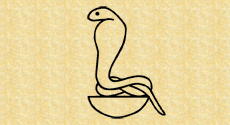

"Wajdet" / "goddess"

Ra and his two mothers Nekhbet (on the left) and Wadjet (on the right)

Masonic symbolism: Serpent, eye and a triangle - all connected to Wadjet


Wadjet was the patron deity of the ancient Stellar cult of Egypt. The priests of the Stellar cult (astronomers, astrologers) were called 'serpent priests' and in their very old tradition the pharaoh was their leader. This is why the serpent became a symbol of the pharaohs and the royalty. Many of the statues of the Egyptian royals have the uraeus cobra on their forehead.


Akhenaton and a cobra on his forehead


You see the connection with the concept of the third eye?


Also, many of the later deities after Wadjet wore the same forehead cobra.


Horus and the cobra

Isis and the cobra


Today the eye symbolism can be seen in many logos:


MI5


And when it comes to the entertainment industry, there is no shortage of eye and serpent symbolism:


(tattoo on the finger)


(Katy Perry album cover)


(Cranberries album cover)

(Daft Punk)